
Introduction: The High-Stakes Balancing Act of Canadian Higher Education
Getting accepted into a top-tier Canadian university is an incredible milestone, but keeping your Grade Point Average (GPA) intact while navigating the actual semesters is an entirely different level of difficulty. From the packed lecture halls of the University of Toronto and McGill University to the intense, research-focused tracks at the University of British Columbia (UBC) and McMaster, Canadian undergraduates are dealing with a fast-paced academic environment. The modern university experience is no longer just about attending lectures and writing notes; it has transformed into a high-stakes balancing act driven by competitive grading curves, massive syllabi, and strict entry caps for upper-year professional programs.
Compounding this academic pressure is the economic reality of living in major Canadian urban centers. With rising housing costs in hubs like Vancouver and Toronto, a significant portion of the student population must balance a part-time job or a demanding co-op placement alongside a full-time course load. This creates a severe case of “time poverty.” When you have multiple midterms, lab reports, and essays all landing in the exact same week, your schedule breaks down. The problem isn’t a lack of discipline or work ethic; it is a simple math problem. There are only so many hours in a week, and trying to give 100% of your energy to five different complex courses simultaneously is a direct path to mental exhaustion and falling grades.
Why Specialized Electives Catch Modern Undergraduates Off Guard
To maintain a competitive edge, many students focus their primary energy on their major requirements, assuming that elective courses will provide an easy GPA boost. However, introductory and intermediate courses in the social and behavioral sciences frequently surprise students with their intense workloads. Writing an empirical research paper or a literature review requires deep analytical focus, extensive knowledge of specific formatting guidelines (such as APA 7th edition), and the ability to interpret complex data sets.
When a student realizes that an elective class demands a 3,000-word research review right when they need to be cramming for a core engineering or finance exam, it creates an immediate academic bottleneck. To keep their grades high across all subjects without risking severe burnout, smart undergraduates look for targeted regional support. Utilizing professional Psychology Assignment Help in Canada has become a standard approach for students who need to turn complex data analyses into polished, high-scoring submissions while keeping their focus on their primary degree requirements. This approach ensures that a single secondary elective does not derail a student’s hard-earned cumulative average.
The Reality of Academic Project Management
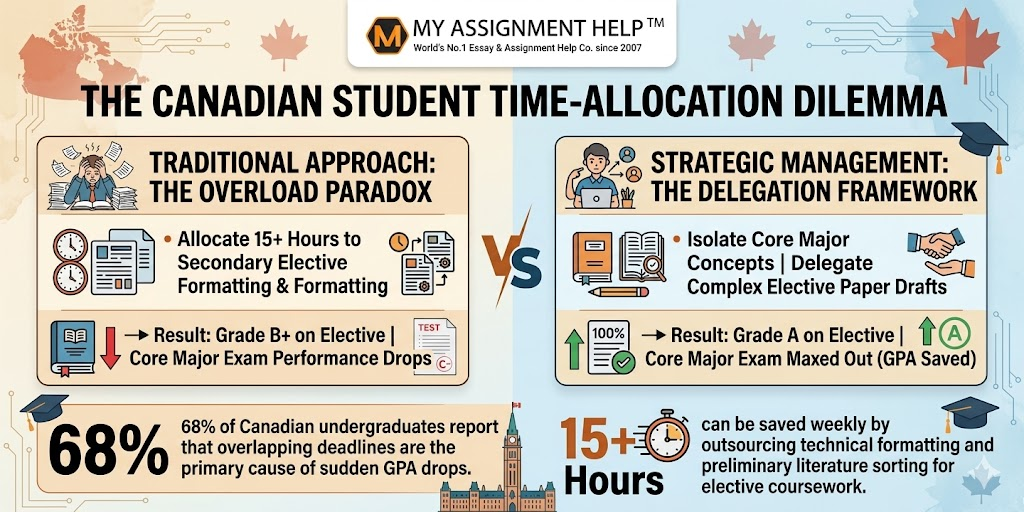
In the professional world, successful managers and executives do not try to complete every single task by themselves. Instead, they look at their goals and delegate operational tasks to specialists so they can focus on high-impact objectives. Modern higher education requires the exact same approach to project management. If you have an organic chemistry or corporate finance exam worth 40% of your total grade on Friday morning, spending your Tuesday night wrestling with a secondary homework assignment is a poor use of your limited time and energy.
When deadlines converge and the risk of a GPA drop becomes real, making the business decision to safely pay to do my assignment is a practical way to manage your workload. It allows you to protect your mental health, fulfill your job commitments, and ensure that every piece of work submitted under your name meets top academic standards. Viewing academic help as an investment in your career management completely changes the script, helping you move from a state of constant panic to calculated, stress-free success.
Workload Management Matrix
| Academic Strain Factor | Traditional Reactionary Approach | Modern Strategic Delegation Framework |
| Time Crunch | Pulling consecutive all-nighters, leading to high error rates on exams. | Outsource time-consuming formatting to clear out hours for active studying. |
| Complex Grading Rubrics | Guessing through difficult formatting guidelines, risking critical point deductions. | Hire subject-matter experts to ensure flawless structure and compliance. |
| Overlapping Deadlines | Submitting rushed, poor-quality drafts just to beat the portal clock. | Maintain a staggered submission schedule by assigning baseline tasks to professional platforms. |
Localized Academic Standards and University Variables
The academic landscape is not identical across Canada; it is heavily shaped by regional university variables and local institutional cultures. For example, large research universities in Ontario and British Columbia operate in highly competitive environments where grades are frequently normalized across tight curves. At institutions like the University of Waterloo or Simon Fraser University, the pressure to secure highly competitive co-op placements early in an academic career means students are essentially running a parallel job hunt alongside their credit hours.
Furthermore, introductory classes at major campuses often feature massive lecture sizes, leaving very little room for one-on-one professor or teaching assistant guidance. When a student gets stuck on a complex grading rubric or an intricate case study, the lack of immediate, accessible support can cause them to fall weeks behind. This structural gap makes targeted external support systems a critical safety valve. By accessing professional, specialized assistance, students can quickly cut through confusing prompt guidelines and keep their academic progress moving forward in a highly competitive landscape.
Conclusion: Driving Success Through Smart Decisions
Achieving a high GPA at a competitive Canadian university does not require you to sacrifice your health or work yourself into the ground. While maintaining academic quality remains a core focus of your degree, true success comes down to how well you manage your time and resources. True academic leadership means recognizing when a workload has become unmanageable and taking proactive steps to fix it.
By treating your semester like a project manager treats a production timeline—learning where to focus your personal energy and where to utilize external scaffolding—you can safely navigate the toughest parts of your syllabus. Utilizing specialized assistance and professional writing platforms is a highly effective tool for smart resource management. This balanced approach ensures that you finish your degree with excellent academic credentials, your mental health intact, and a clear path toward your future career goals.
See also: Why is bathroom safety important for elderly and disabled individuals?
Frequently Asked Questions (FAQ)
1. Why do elective courses often create academic bottlenecks for Canadian students?
Electives, particularly in the behavioral and social sciences, frequently require time-consuming empirical reviews and complex formatting rules (like APA guidelines) that catch students off guard, stealing valuable time away from their core major exams.
2. How does academic delegation improve a student’s overall GPA?
By outsourcing secondary assignments or time-heavy formatting tasks to professional services, students can protect their schedules and focus their energy on high-stakes midterms and major projects, raising their grades across the board.
3. Is utilizing external academic help common among top-performing students?
Yes. High-achieving students often look at their course loads through a project management lens. They view strategic delegation as a practical way to manage time, balance jobs, and protect their mental well-being during intense weeks.
4. How do regional factors in provinces like Ontario and BC affect student workloads?
Competitive co-op programs and higher living costs in major urban centers force students to balance long work hours alongside strict university grading curves, making smart time management absolute essential for survival.
Author Profile
Dr. Aris Thorne is an Academic Content Specialist and Senior Research Consultant at MyAssignmentHelp. Holding a PhD in Educational Psychology from a top Canadian university, Dr. Thorne focuses on cognitive load management, student development frameworks, and the evolution of modern, strategic study behaviors across North American higher education.
References
- Curran, T., & Hill, A. P. (2019). Perfectionism is increasing over time: A meta-analysis of birth cohort differences from 1989 to 2016. Psychological Bulletin, 145(4), 410-429.
- National College Health Assessment (NCHA). (2023). Canadian Reference Group Data Report. American College Health Association.
- Saini, M. (2024). The economics of higher education and mental health outcomes across Canadian urban student centers. Canadian Journal of Higher Education, 54(2), 112-128.
